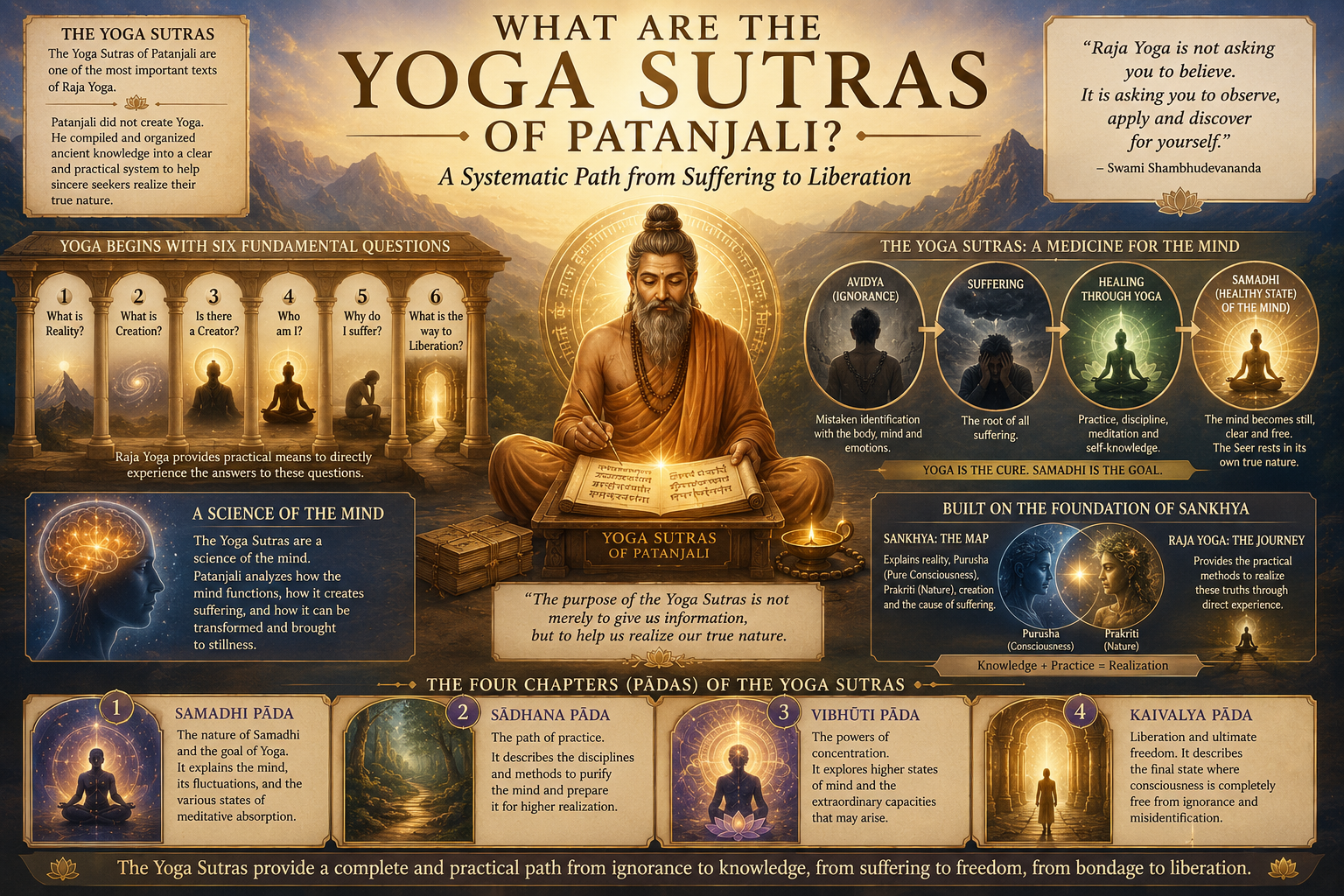
The yoga sutra of Patanjali
Raja Yoga-
MIP Study group
Lesson 5
Arjuna's Crisis: The Beginning of the Spiritual Journey
The Battlefield of Kurukshetra
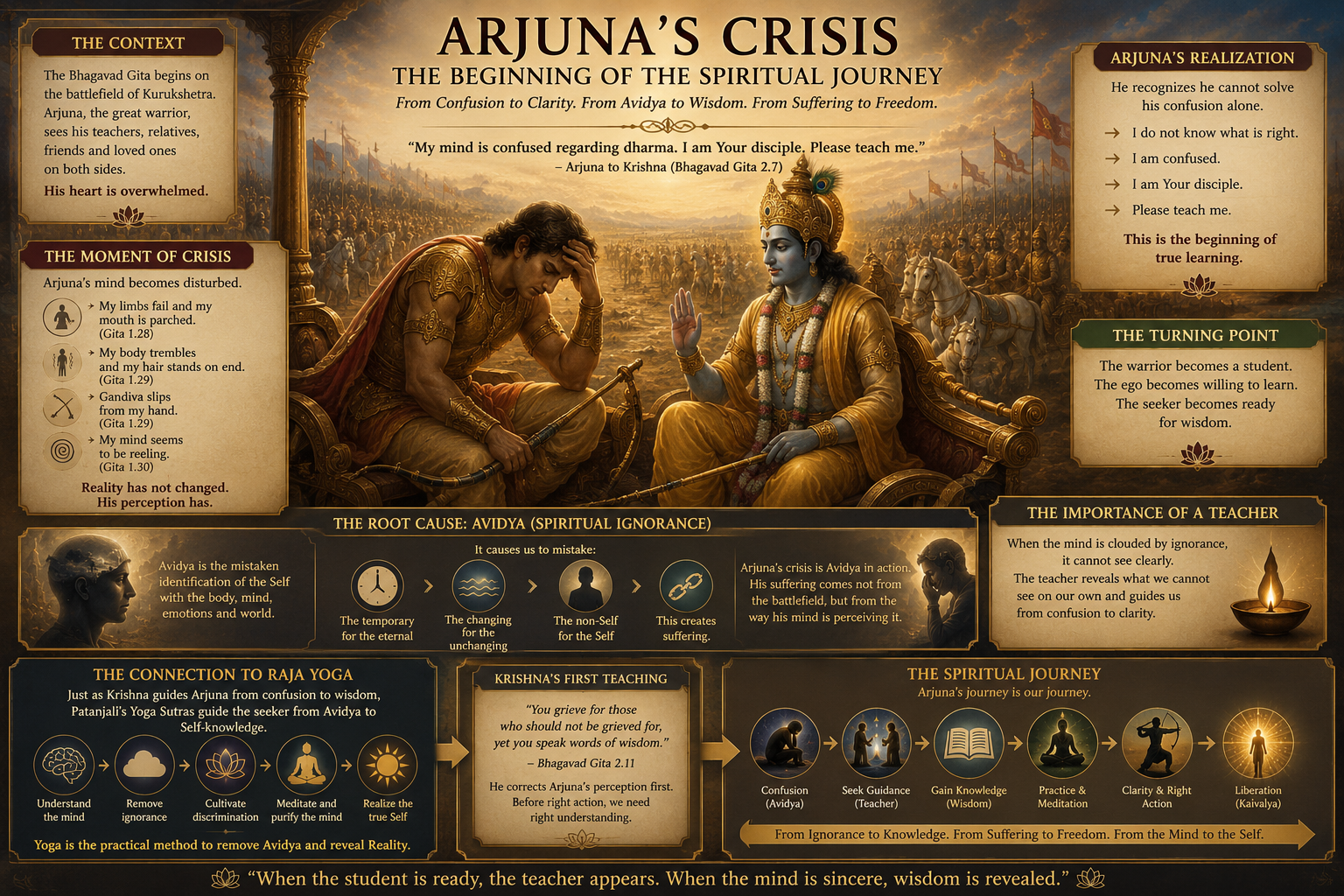
The Bhagavad Gita begins on the battlefield of Kurukshetra.
Two armies stand facing one another, preparing for a great war that will determine the future of a kingdom.
Arjuna, one of the greatest warriors of his time, asks Krishna to place their chariot between the two armies so that he may observe those assembled for battle.
As he looks across the battlefield, he sees not enemies, but teachers, relatives, friends, mentors, and loved ones.
At that moment, something unexpected happens.
The great warrior begins to collapse internally.
The Symptoms of a Disturbed Mind
The Bhagavad Gita begins on the battlefield of Kurukshetra.
Two armies stand facing one another, preparing for a great war that will determine the future of a kingdom.
Arjuna, one of the greatest warriors of his time, asks Krishna to place their chariot between the two armies so that he may observe those assembled for battle.
As he looks across the battlefield, he sees not enemies, but teachers, relatives, friends, mentors, and loved ones.
At that moment, something unexpected happens.
The great warrior begins to collapse internally.
The Symptoms of a Disturbed Mind
Arjuna describes his condition:
“My limbs fail and my mouth is parched. My body trembles and my hair stands on end.”
“Gandiva slips from my hand.”
“My mind seems to be reeling.”
Although nothing external has changed, Arjuna can no longer perceive reality clearly.
His emotions overwhelm his reason.
His attachment clouds his judgment.
Fear distorts his perception.
The battlefield remains the same, but the mind interpreting it has become disturbed.
Arjuna as a Symbol of Every Seeker
According to the yogic tradition, Arjuna represents all of us.
Every sincere seeker eventually encounters their own Kurukshetra.
We face situations that challenge our attachments, beliefs, expectations, fears, and identity.
Like Arjuna, we may feel confused, uncertain, overwhelmed, or unable to determine the right course of action.
The battlefield is not only external.
It exists within the mind.
The Role of Avidya
In Raja Yoga, Patanjali identifies the root cause of suffering as Avidya, spiritual ignorance.
Avidya is the mistaken identification of the Self with the body, mind, emotions, thoughts, and experiences.
It causes us to mistake the temporary for the eternal.
The changing for the unchanging.
The non-Self for the Self.
Arjuna’s crisis is a perfect example of Avidya in action.
He is no longer seeing reality as it is.
He is seeing reality through the filters of attachment, fear, grief, and emotional identification.
His suffering is not created by the battlefield itself.
It is created by the way his mind is interpreting the battlefield.
Why We Need a Teacher
One of the most important lessons of the Bhagavad Gita is that Arjuna cannot free himself from his confusion alone.
He recognizes the limitations of his own understanding and turns to Krishna for guidance.
He says:
“My mind is confused regarding dharma. I am Your disciple. Please teach me.”
This moment marks the true beginning of the spiritual journey.
The warrior becomes a student.
The ego becomes willing to learn.
The seeker becomes receptive to wisdom.
This is why the guidance of a teacher is so important in Raja Yoga.
When the mind is clouded by ignorance, it cannot easily recognize its own errors.
The teacher helps remove confusion, reveal blind spots, and guide the seeker toward a clearer perception of reality.
Krishna's First Teaching
Krishna does not immediately tell Arjuna what action to take.
Instead, he begins by correcting Arjuna’s perception.
He says:
“You grieve for those who should not be grieved for, yet you speak words of wisdom.”
Krishna begins by addressing ignorance.
Before action can become correct, perception must become correct.
Before outer transformation, there must be inner clarity.
The Connection to Raja Yoga
The Yoga Sutras of Patanjali serve a similar purpose.
Just as Krishna guides Arjuna from confusion to wisdom, Patanjali guides the seeker from Avidya to Self-knowledge.
The Yoga Sutras teach us:
- How the mind creates suffering.
- How perception becomes distorted.
- How attachment clouds judgment.
- How ignorance hides our true nature.
- How meditation restores clarity.
The goal of Raja Yoga is not simply relaxation or stress reduction.
Its goal is to remove Avidya and reveal Reality.
From Arjuna to Samadhi
Arjuna’s journey mirrors the journey of every practitioner of Raja Yoga.
He begins in confusion.
He seeks guidance.
He gains knowledge.
He learns discrimination.
He transforms his understanding.
Eventually, he is able to act from clarity rather than confusion.
This is the same movement described by Patanjali:
From ignorance to knowledge.
From suffering to freedom.
From identification to Self-realization.
From the disturbed mind to Samadhi.
In this way, the crisis of Arjuna is not merely the beginning of the Bhagavad Gita.
It is the beginning of the spiritual journey itself.
The Map of Reality: From Duality to Absolute Consciousness
Swamiji's Teachings on Sankhya Philosophy
Why Study Sankhya Philosophy?
According to Swami Shambhudevananda, in order to understand yogic philosophy, the Yoga Sutras, how Patanjali unfolds the subject of Yoga, why we learn it, why we practice it, and what its purpose is, we must first understand Sankhya Philosophy.
Sankhya is one of the six orthodox systems of Indian philosophy. These systems are known as the Astika schools because they derive their authority from the Vedas and the Upanishads.
The study of Sankhya is important because it provides the philosophical vision upon which Raja Yoga is built.
Before learning how to restrain the modifications of the mind, it is necessary to understand the nature of reality, the process of creation, and how human beings become identified with different levels of existence.
For this reason, Sankhya serves as an essential foundation for the study of Raja Yoga and the Yoga Sutras of Patanjali.
The Six Orthodox Systems of Indian Philosophy
Sankhya is one of the six orthodox systems of Indian philosophy, known as the Astika schools.
These philosophical systems derive their authority from the Vedas and the Upanishads and seek to understand the nature of reality, knowledge, existence, and liberation.
The six systems are:
- Nyaya
- Vaisheshika
- Sankhya
- Yoga
- Purva Mimamsa
- Uttara Mimamsa (Vedanta)
Swamiji explains that Purva Mimamsa is the inquiry into the earlier portion of the Vedas, which deals primarily with rituals and karma.
Uttara Mimamsa, also known as Vedanta, is the inquiry into the later portion of the Vedas, particularly the Upanishads and the teachings concerning knowledge and liberation.
Although these systems have different approaches and methods, they all draw their authority from the same sacred source: the Vedas and the Upanishads.
Sankhya occupies a special place because it provides the philosophical framework that supports the study and practice of Raja Yoga.
Sankhya and Vedanta Draw from the Same Source
Before explaining the differences between Sankhya and Vedanta, Swamiji emphasizes an important point.
When studying Vedanta, we often encounter concepts that also appear in Sankhya Philosophy. This may create the impression that Vedanta borrows its teachings from Sankhya.
According to Swamiji, this is not the case.
Both Sankhya and Vedanta derive their knowledge from the same source: the Vedas and the Upanishads.
The descriptions that we find in Sankhya are also found in the Upanishads. The difference lies not in the source of knowledge, but in the interpretation of that knowledge.
Sankhya accepts the descriptions found in the Upanishads as literal descriptions of reality and creation.
For example, when the Upanishads describe the emergence of space, air, fire, water, and earth, Sankhya understands this as an actual description of how creation unfolds.
Vedanta approaches these descriptions differently.
According to Vedanta, these teachings are part of a pedagogical process designed to guide the student toward the realization of the ultimate reality.
The descriptions are given first, but later they are negated so that the student can recognize that the Absolute Reality is beyond all descriptions, forms, and processes.
Therefore, both Sankhya and Vedanta draw from the same sacred source, yet they arrive at different philosophical conclusions through different methods of interpretation.
The Vedantic Method: Superimposition and Negation
Swamiji explains that one of the major differences between Sankhya and Vedanta lies in how they interpret the descriptions found in the Upanishads.
Sankhya accepts these descriptions as literal explanations of reality and creation.
Vedanta, however, understands them as part of a teaching method.
This method is known as superimposition and negation.
Adi Shankaracharya summarizes this process with the expression:
Adhyaropa Apavada
which means:
Superimposition followed by negation.
According to this method, the teacher initially presents a description of reality in a way that the student’s mind can understand.
For example, the teacher may say that Brahman is the source from which space, air, fire, water, and earth emerge.
The student begins to contemplate Brahman as the source of creation.
Later, the teacher gradually negates these descriptions.
The purpose of this negation is not to contradict the earlier teaching but to help the student recognize that Brahman is beyond all objects, qualities, forms, and descriptions.
Swamiji explains that Brahman cannot be known as an object because Brahman is the very reality by which all objects are known.
Therefore, Vedanta first allows the student to think about Brahman in a particular way and then removes those conceptual supports.
What remains after all superimpositions are removed is the direct recognition of Reality itself.
For this reason, Vedanta views many descriptions of creation as teaching tools rather than literal explanations of how reality ultimately exists.
Sankhya, on the other hand, accepts these descriptions as actual descriptions of the structure and evolution of reality.
Why Sankhya Is a Dualistic Philosophy
According to Swamiji, the main difference between Sankhya and Vedanta is that Sankhya is a dualistic philosophy.
Sankhya agrees with the Upanishads that there is an ultimate reality that is beyond change, beyond qualities, beyond action, and beyond modification.
This reality is called Purusha, pure consciousness.
Purusha is awareness itself.
It is eternal, unchanging, and completely free from all qualities.
However, Sankhya asks an important question:
If pure consciousness is without qualities, without change, and without action, then where do all the qualities, diversity, movement, and modifications that we observe in the world come from?
Everywhere we look, we see differences.
We see trees, animals, mountains, rivers, stars, human beings, thoughts, emotions, and experiences.
We see movement, transformation, birth, growth, decay, and death.
According to Sankhya, all of these qualities must come from somewhere.
Since Purusha is completely devoid of qualities, Sankhya concludes that there must be another eternal principle that serves as the source of all manifestation.
This second principle is called Prakriti.
Prakriti is nature.
It is the storehouse of all qualities in their unmanifested form.
Everything that can be experienced, perceived, felt, thought, or known belongs to the realm of Prakriti.
Therefore, Sankhya teaches that reality consists of two eternal principles:
Purusha
Pure Consciousness
- Awareness itself
- Unchanging
- Without qualities
- Without action
- The witness of all experience
Prakriti
Nature
- The source of all qualities
- The source of all manifestation
- Dynamic and creative
- The cause of diversity and change
For this reason, Sankhya is considered a dualistic philosophy.
Unlike Vedanta, which ultimately teaches that there is only one reality, Sankhya maintains that both Purusha and Prakriti are real and eternal.
According to Sankhya, the entire universe arises through the interaction between these two fundamental principles.
Purusha and Prakriti: The Blind Man and the Lame Man
Having established that reality consists of two eternal principles—Purusha and Prakriti—Sankhya now explains how creation becomes possible.
Swamiji uses a traditional analogy to illustrate this relationship.
Purusha is compared to a lame man who can see but cannot walk.
Prakriti is compared to a blind man who can walk but cannot see.
Individually, neither can accomplish very much.
The lame man possesses vision but lacks the ability to move.
The blind man possesses the power of movement but lacks awareness and direction.
Together, however, they can fulfill a common purpose.
The blind man says to the lame man:
“Climb onto my shoulders. You will be my eyes, and I will be your legs.”
In the same way, Purusha provides awareness, while Prakriti provides the capacity for action, movement, and manifestation.
Purusha is consciousness but has no qualities, no activity, and no means of acting.
Prakriti possesses all qualities, energy, movement, and creative potential, but by itself it is unconscious.
Creation becomes possible only through their association.
Purusha illuminates.
Prakriti manifests.
Purusha witnesses.
Prakriti acts.
Purusha is the light.
Prakriti is the vehicle through which that light becomes expressed.
This union explains how an unconscious universe can appear intelligent and how pure consciousness can seem to participate in creation while remaining unchanged.
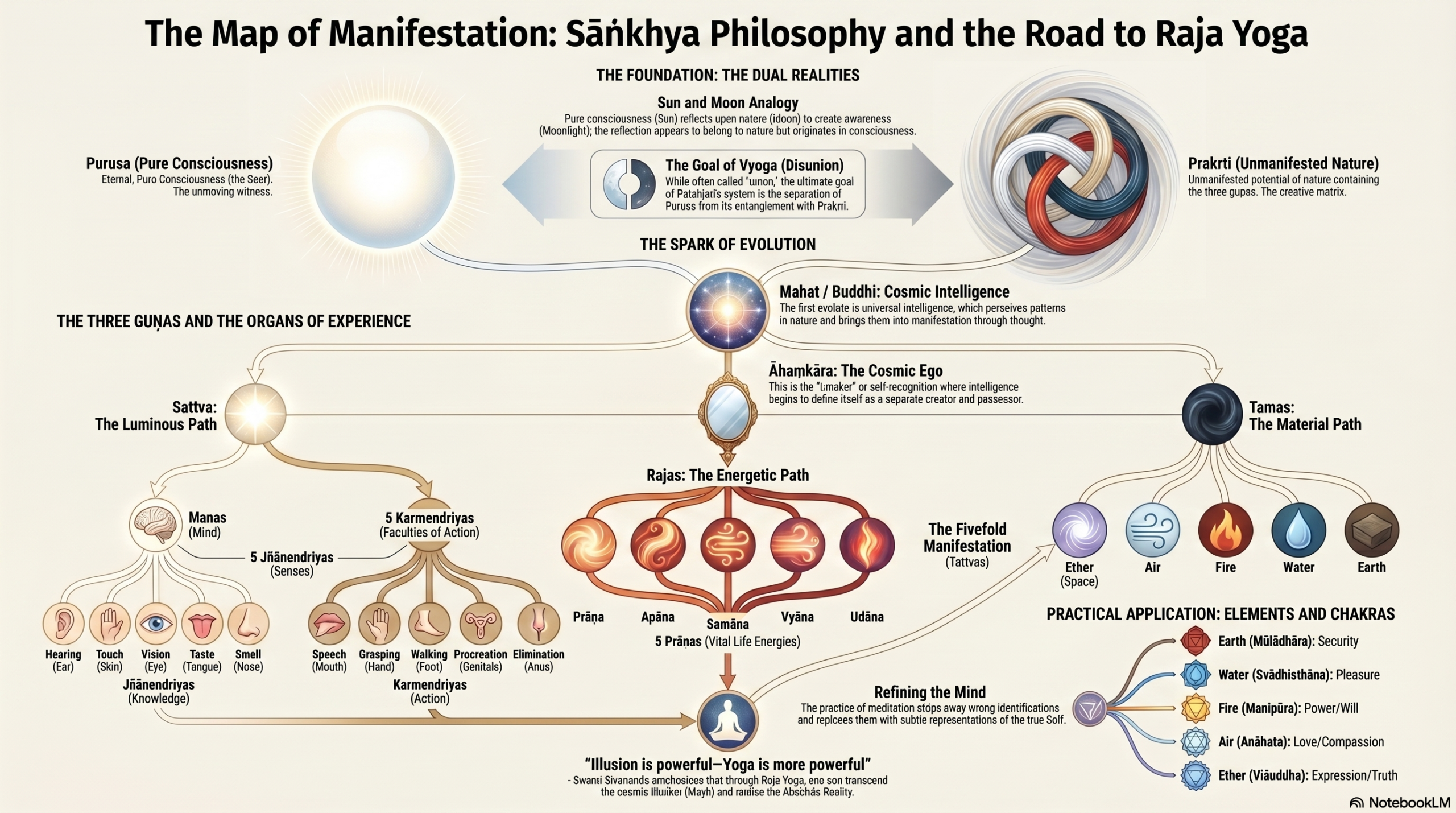
According to Sankhya, the entire process of evolution begins when the light of Purusha shines upon Prakriti.
It is this contact that initiates the unfolding of creation.
The Three Gunas and the Beginning of Creation
According to Sankhya, Prakriti is composed of three fundamental qualities known as the Gunas.
These three Gunas are:
Sattva
The principle of harmony, balance, clarity, intelligence, and light.
Rajas
The principle of activity, movement, energy, and change.
Tamas
The principle of inertia, stability, density, and resistance.
Before creation begins, these three Gunas exist in a state of perfect equilibrium within Prakriti.
Because they are perfectly balanced, Prakriti remains unmanifest.
Nothing is yet expressed.
Nothing is differentiated.
Nothing has emerged into creation.
Creation begins when the light of Purusha shines upon Prakriti.
According to Swamiji, the presence of consciousness disturbs the equilibrium of the three Gunas.
The balance is broken.
Sattva becomes dominant.
And for the first time, consciousness becomes reflected within nature.
This reflection is a crucial moment in Sankhya Philosophy.
Before this, there is pure consciousness and there is nature.
Now, through the reflection of consciousness in Sattva, a completely new principle appears.
This is the first manifestation of creation.
This is the birth of Mahat, the Cosmic Intelligence.
The entire process of creation unfolds from this first awakening.
Without the disturbance of the Gunas, creation would remain in a dormant and unmanifest state.
With the reflection of consciousness in Sattva, the cosmic process begins.
The Birth of Mahat: Cosmic Intelligence
When the equilibrium of the three Gunas is disturbed and Sattva becomes dominant, consciousness is reflected within Sattva.
According to Swamiji, this reflection gives rise to the first manifestation of creation:
Mahat, the Cosmic Intelligence.
Mahat is also known as:
- Cosmic Intelligence
- Cosmic Mind
- Hiranyagarbha
- Brahma, the Creator
Before this moment, there is consciousness and there are qualities, but there is not yet intelligence.
Intelligence appears when awareness is reflected in Sattva.
Swamiji explains that intelligence is the union of consciousness and the qualities of nature.
This Cosmic Intelligence contains the entire potential of creation.
However, at this stage, creation has not yet fully unfolded.
The intelligence exists, but it remains in a potential state.
To illustrate this, Swamiji uses the example of a sleeping genius.
A person may possess extraordinary intelligence, creativity, and knowledge, but while asleep, none of these capacities are being expressed.
The potential is present, but it is not yet active.
In the same way, Mahat contains the entire potential of creation, but it has not yet awakened to itself.
The next stage begins when Cosmic Intelligence awakens and becomes aware of its own existence.
This awakening gives rise to the first sense of individuality and marks the beginning of the further evolution of creation.
For this reason, Mahat is called the first-born of creation.
It is the spark from which the entire universe will eventually emerge.
The Awakening of Cosmic Intelligence: "I Am"
After the birth of Mahat, Cosmic Intelligence exists, but its potential has not yet been fully expressed.
Swamiji explains that intelligence can only begin to manifest when it awakens.
To help us understand this process, he invites us to observe our own experience upon waking from sleep.
When we wake up naturally, there is a moment when intelligence begins to function.
The eyes open.
Awareness becomes active.
And intelligence begins recognizing patterns.
The first recognition is simple:
“I am awake.”
Then other recognitions follow.
“Where am I?”
“Who am I?”
As these recognitions arise, memory begins to return.
Our identity, our experiences, our responsibilities, and our understanding of the world gradually come back into awareness.
According to Sankhya, a similar process occurs on the cosmic level.
When Cosmic Intelligence awakens, its first realization is:
“I Am.”
At this stage, there is not yet the thought:
“I am this.”
“I am that.”
There is only the pure awareness of existence itself.
This primordial sense of existence is called Asmita.
Swamiji points out that this is not yet the individual ego.
It is not the personal “I” that identifies with a body, a personality, or a story.
Rather, it is the cosmic sense of existence, the first awareness of being.
Once this awakening occurs, the impressions of previous creations begin to emerge.
The Cosmic Intelligence becomes capable of recognizing patterns and expressing its latent potential.
Creation can now continue to unfold.
What was previously dormant begins to manifest.
What was hidden within potential begins to take form.
The awakening of Asmita therefore marks a crucial stage in the evolution of creation.
The universe has not yet appeared in its full diversity, but the Cosmic Intelligence has become aware of its own existence and is now ready to manifest the vast potential contained within Prakriti.
The Evolution of Creation Through the Three Gunas
Once Cosmic Intelligence awakens and the primordial sense of existence, Asmita, appears, creation begins to unfold through the three Gunas.
What previously existed in a potential state now starts to become manifest.
According to Swamiji, the three Gunas express themselves in different ways and give rise to different aspects of creation.
The Evolution of Sattva
From Sattva arise all the instruments that allow knowledge, perception, recognition, and understanding.
These include:
- The mind (Manas)
- The intellect (Buddhi)
- The subconscious mind (Chitta)
- The sense of individuality (Ahamkara)
- The five organs of knowledge
Together, these form what is known as the Antahkarana, the inner instrument.
These are the faculties that allow us to perceive, interpret, understand, and make meaning of our experiences.
Swamiji explains that Sattva is responsible for everything related to knowledge, cognition, and awareness.
The Evolution of Rajas
From Rajas arise movement, energy, activity, and expression.
Rajas gives birth to:
- The five Pranas
- The five organs of action
After perception comes reaction.
Rajas governs our capacity to act, move, express ourselves, grasp, communicate, create, and interact with the world.
If Sattva allows intelligence to perceive, Rajas allows intelligence to respond.
The Evolution of Tamas
From Tamas arise the objects of experience.
First emerge the subtle elements.
These subtle elements form the basis of our inner experiences.
Swamiji explains that even in dreams we experience solidity, movement, heat, emotion, sound, and sensation despite the absence of physical objects.
These experiences arise from the subtle elements.
As the process continues, the subtle elements become grossified and manifest as the objective universe.
From them arise the physical elements and the material world that we perceive through our senses.
This is the level of creation that appears as mountains, rivers, trees, animals, planets, stars, and physical bodies.
A Complete Map of Creation
According to Sankhya, this process describes the entire evolution of creation.
From Purusha and Prakriti arise:
- Cosmic Intelligence (Mahat)
- Asmita
- The mind
- The senses
- The Pranas
- The subtle elements
- The gross elements
- The objective universe
Swamiji explains that Sankhya provides a complete map that describes every level of reality, from the most subtle to the most gross.
Understanding this map is essential because it helps us understand not only the universe around us but also the different layers through which we experience ourselves.
Why Human Birth Is So Precious
After describing the entire process of creation, Swamiji explains why human birth occupies a unique position within Sankhya Philosophy.
According to Sankhya, the human being contains within himself every level of creation.
Within our direct experience, we find:
- The gross physical body
- The senses
- The organs of action
- The Pranas
- The mind
- The intellect
- The ego
- The subconscious mind
- The subtle elements
- The gross elements
No other form of life possesses such a complete and direct participation in all levels of creation.
Swamiji explains that in other forms of existence, certain aspects may be present while others are absent.
An animal may possess some faculties but not the fully developed discriminative intellect.
A celestial being may possess extraordinary intelligence but lack direct engagement with the gross material world.
Only the human being has immediate access to all dimensions of creation.
For this reason, the human birth is considered extremely valuable.
We do not need to go anywhere else.
We do not need to acquire anything new.
Everything required for Self-realization is already present within our own experience.
The entire map of creation exists within us.
This unique position allows us to inquire into the nature of reality and investigate every level with which we identify.
We can observe the body.
We can observe the senses.
We can observe the mind.
We can observe thoughts, emotions, memories, desires, and experiences.
And because we can observe them, we can begin to question whether they truly define who we are.
According to Swamiji, this possibility exists most fully in human birth.
Only the human being possesses the capacity to consciously undertake the journey of Self-inquiry and ultimately realize that he is not any of the elements of creation with which he has become identified.
For this reason, human birth is considered a rare opportunity and a precious gateway to liberation.
The Real Problem: Identification
After describing the various levels of creation, Swamiji explains that the problem is not creation itself.
The problem is identification.
Human beings become identified with the different layers of creation and mistakenly believe them to be their true nature.
We say:
- I am the body.
- I am the mind.
- I am my emotions.
- I am my thoughts.
- I am my memories.
- I am my experiences.
These identifications feel natural and obvious.
For most people, they are never questioned.
According to Sankhya, however, these identifications are mistaken.
The body is experienced, but it is not who we are.
Thoughts are experienced, but they are not who we are.
Emotions are experienced, but they are not who we are.
The senses are experienced.
The mind is experienced.
Even the intellect and the sense of individuality are experienced.
Yet the experiencer remains distinct from all of them.
Swamiji explains that spiritual awakening begins when a person becomes willing to question these compulsive identifications.
The spiritual seeker still experiences identification, but something has changed.
He begins to suspect that what he takes himself to be may not be his true nature.
He begins to recognize that there is a difference between what is observed and the one who observes.
This questioning marks the beginning of genuine spiritual inquiry.
The seeker starts to investigate:
If I can observe the body, am I the body?
If I can observe my thoughts, am I my thoughts?
If I can observe my emotions, am I my emotions?
If I can observe my mind, who is the observer?
This investigation gradually reveals that the true Self is not any object of experience.
According to Sankhya, our true nature is Purusha, pure consciousness, the witness of all experience.
The journey of Yoga therefore begins with recognizing the difference between the observer and the observed.
The body changes.
The mind changes.
Thoughts come and go.
Emotions arise and disappear.
Experiences appear and vanish.
But the witnessing consciousness remains unchanged.
Understanding this distinction is the first step toward freedom from suffering and the beginning of the path to Self-realization.
The Role of the Guru
Having recognized the problem of identification, the next question becomes:
How do we free ourselves from it?
According to Swamiji, this is where the role of the Guru becomes essential.
One of the most profound teachings in this lecture is his explanation of ignorance.
Ignorance is not simply the absence of knowledge.
It is not merely that we do not know the truth.
Ignorance is an active force that causes us to think incorrectly and then believe that our incorrect thinking is true.
As Swamiji explains:
We are not only unaware of reality.
We are actively misunderstanding reality.
We see through the filters of conditioning, habits, attachments, fears, desires, emotions, memories, and deeply rooted patterns of thought.
As a result, we continuously reinforce our mistaken identifications.
This is why spiritual growth cannot rely solely on our own opinions and interpretations.
The very instrument we are using to understand reality—the mind—is itself conditioned by ignorance.
The Guru helps us recognize these blind spots.
The Guru helps us see where our thinking is distorted.
The Guru helps us question assumptions that we have taken for granted throughout our lives.
Swamiji explains that this process is not always comfortable.
To allow someone to challenge our beliefs, our interpretations, and our deeply held convictions requires humility.
It requires a willingness to admit that our current understanding may be incomplete.
It requires a willingness to let go of familiar ways of thinking.
For this reason, spiritual growth is often accompanied by discomfort.
Old patterns must be questioned.
Old conclusions must be examined.
Old identifications must be released.
The Guru does not give us a new identity.
The Guru helps remove false identities.
The Guru does not create the truth.
The Guru helps remove the obstacles that prevent us from recognizing it.
This is why the traditional relationship between student and teacher occupies such an important place in the yogic tradition.
The student seeks guidance not because the Guru possesses something the student lacks, but because the Guru sees clearly what the student is not yet able to see.
The role of the Guru is to guide the seeker from confusion to clarity, from ignorance to knowledge, and from identification to freedom.
By Prostration, By Question, and By Service
After explaining the importance of the Guru, Swamiji turns to a teaching from the Bhagavad Gita that describes how a student should approach spiritual learning.
Krishna advises Arjuna to approach the teacher through:
Prostration. Questioning. Service.
Swamiji explains that these three practices are not external rituals alone. They are powerful tools for transforming the mind and preparing it for knowledge.
By Prostration
Prostration represents humility.
It is the willingness to recognize that our current understanding may be incomplete.
It is the willingness to let go of pride and become teachable.
Swamiji emphasizes that this humility is not a one-time event.
It is a long-term process.
The student gradually learns to stop defending every opinion, every reaction, and every mental habit.
Instead, the student becomes receptive to guidance.
By Question
Questioning is an essential part of spiritual growth.
The student is encouraged to inquire, reflect, and seek clarification.
However, questioning is not performed to defend one’s existing beliefs.
It is performed to remove confusion.
The purpose of questioning is to allow the teacher to expose mistaken assumptions and incorrect patterns of thinking.
According to Swamiji, ignorance actively causes us to think incorrectly.
Through sincere questioning, these hidden errors can gradually be revealed and corrected.
By Service
Service, or Karma Yoga, plays a central role in preparing the mind.
When actions are performed selflessly and offered to a higher purpose, the mind becomes purified.
Self-centered tendencies gradually weaken.
Attachments begin to loosen.
The student learns to act without constantly reinforcing the ego.
Swamiji explains that service performed in the proper spirit becomes a powerful means of inner transformation.
Preparing the Mind for Higher Knowledge
Through humility, inquiry, and selfless service, the student gradually becomes ready for deeper spiritual understanding.
The mind becomes calmer.
The ego becomes less dominant.
The grip of identification begins to weaken.
This preparation is essential because the teachings of Yoga are not merely intellectual concepts.
They require a mind that is sufficiently clear, receptive, and refined to recognize the truth.
For this reason, Krishna places great emphasis on prostration, questioning, and service as foundational attitudes of the spiritual seeker.
These practices prepare the ground upon which true knowledge can arise.
Why Karma Yoga and Bhakti Yoga Prepare the Mind for Raja Yoga
According to Swamiji, the teachings of Raja Yoga cannot be fully assimilated by a mind that remains heavily identified with its habitual patterns of thinking, reacting, and perceiving.
Before the direct discipline of Raja Yoga can begin, the mind must first undergo a process of purification.
This is why Karma Yoga and Bhakti Yoga play such an important role on the spiritual path.
The Purification of the Mind
Through Karma Yoga, the seeker learns to act without constantly reinforcing personal desires, attachments, and ego-centered motivations.
Actions are gradually offered to a higher purpose.
The mind becomes less reactive and less self-centered.
Old conditioning begins to loosen.
The Transformation Through Devotion
Bhakti Yoga adds another essential element.
Through devotion, surrender, prayer, and remembrance of the Divine, the seeker gradually shifts attention away from personal preferences and limitations.
Instead of constantly revolving around “me” and “mine,” the mind begins turning toward something greater than itself.
This softens the ego and creates greater receptivity to spiritual knowledge.
Learning to Let Go of Wrong Thinking
Swamiji repeatedly emphasizes that ignorance is not merely the absence of knowledge.
Ignorance actively causes us to think incorrectly.
As long as the mind remains completely identified with its habitual ways of thinking, genuine spiritual understanding remains difficult.
Karma Yoga, Bhakti Yoga, and the guidance of the Guru help the seeker gradually release these patterns.
The student becomes more humble.
More receptive.
More willing to question deeply held assumptions.
More willing to let go of mistaken perceptions.
Preparing for Raja Yoga
As this purification takes place, the mind becomes increasingly capable of concentration, discrimination, and self-observation.
The seeker becomes ready to examine the workings of the mind directly.
He becomes ready to investigate identification.
He becomes ready to inquire into the nature of consciousness itself.
Only then does the direct discipline of Raja Yoga truly begin.
For this reason, Swamiji explains that Karma Yoga and Bhakti Yoga are not separate from Raja Yoga.
They prepare the mind for Raja Yoga.
They create the inner conditions necessary for the deeper work of meditation, self-inquiry, and liberation.
Yoga Sutra 1.1 — Atha Yogānuśāsanam
Sanskrit
अथ योगानुशासनम्
Atha Yogānuśāsanam
Translation
“Now, the teaching of Yoga begins.”
Atha Yoga Anushasanam: Now the Teaching of Yoga Begins
After presenting the vision of Sankhya, the process of creation, the problem of identification, the role of the Guru, and the importance of Karma Yoga and Bhakti Yoga, Swamiji arrives at the first sutra of Patanjali:
Atha Yoga Anushasanam
“Now, the teaching of Yoga begins.”
According to Swamiji, the word “Now” is extremely significant.
Patanjali is not speaking to everyone.
He is speaking to a particular kind of student.
A student who has begun to awaken.
A student who has started to recognize that something is not right.
A student who has begun to question the compulsive identifications that dominate ordinary life.
The Beginning of Spiritual Awakening
For most people, identification feels completely natural.
“I am the body.”
“I am the mind.”
“I am my emotions.”
“I am my thoughts.”
These assumptions are rarely questioned.
The spiritual seeker, however, begins to notice something different.
Although the identification is still present, he begins to suspect that it may not represent the whole truth.
He starts to question:
Who am I really?
Am I the body?
Am I the mind?
Am I the experiencer, or am I the witness of experience?
This questioning marks the beginning of spiritual awakening.
A Prepared Mind
According to Swamiji, the student who is ready for Yoga is not simply someone who has read books or accumulated knowledge.
The prepared student has undergone a process of inner refinement.
Through Karma Yoga, the mind has become less self-centered.
Through Bhakti Yoga, the heart has become softer and more receptive.
Through the guidance of the Guru, mistaken perceptions have begun to be corrected.
Through inquiry, humility, and service, the seeker has become willing to let go of old patterns of thinking.
Only such a student is truly ready for the discipline of Yoga.
The Purpose of Raja Yoga
At this stage, Patanjali introduces the central teaching of Raja Yoga.
The purpose of Yoga is to restrain the compulsive modifications of the mind.
The mind is constantly reacting.
Constantly interpreting.
Constantly identifying.
Constantly moving outward.
These movements create confusion and reinforce ignorance.
Yoga reverses this process.
It gradually quiets the mind and frees it from its habitual patterns.
As the modifications become restrained, the underlying reality begins to reveal itself.
The Journey Toward Freedom
The entire purpose of Sankhya Philosophy is to help us understand the structure of creation and the mechanism of identification.
The entire purpose of Raja Yoga is to free us from that identification.
Sankhya shows us the map.
Raja Yoga teaches us how to travel.
Sankhya explains the problem.
Raja Yoga provides the solution.
When the seeker becomes ready, Patanjali opens the door and says:
Atha Yoga Anushasanam.
Now, the teaching of Yoga begins.
Slowing down the Mind
Raja Yoga Teachings with Swami Shambhudevananda