The yoga sutra of Patanjali
Raja Yoga-
MIP Study group
Lesson 4
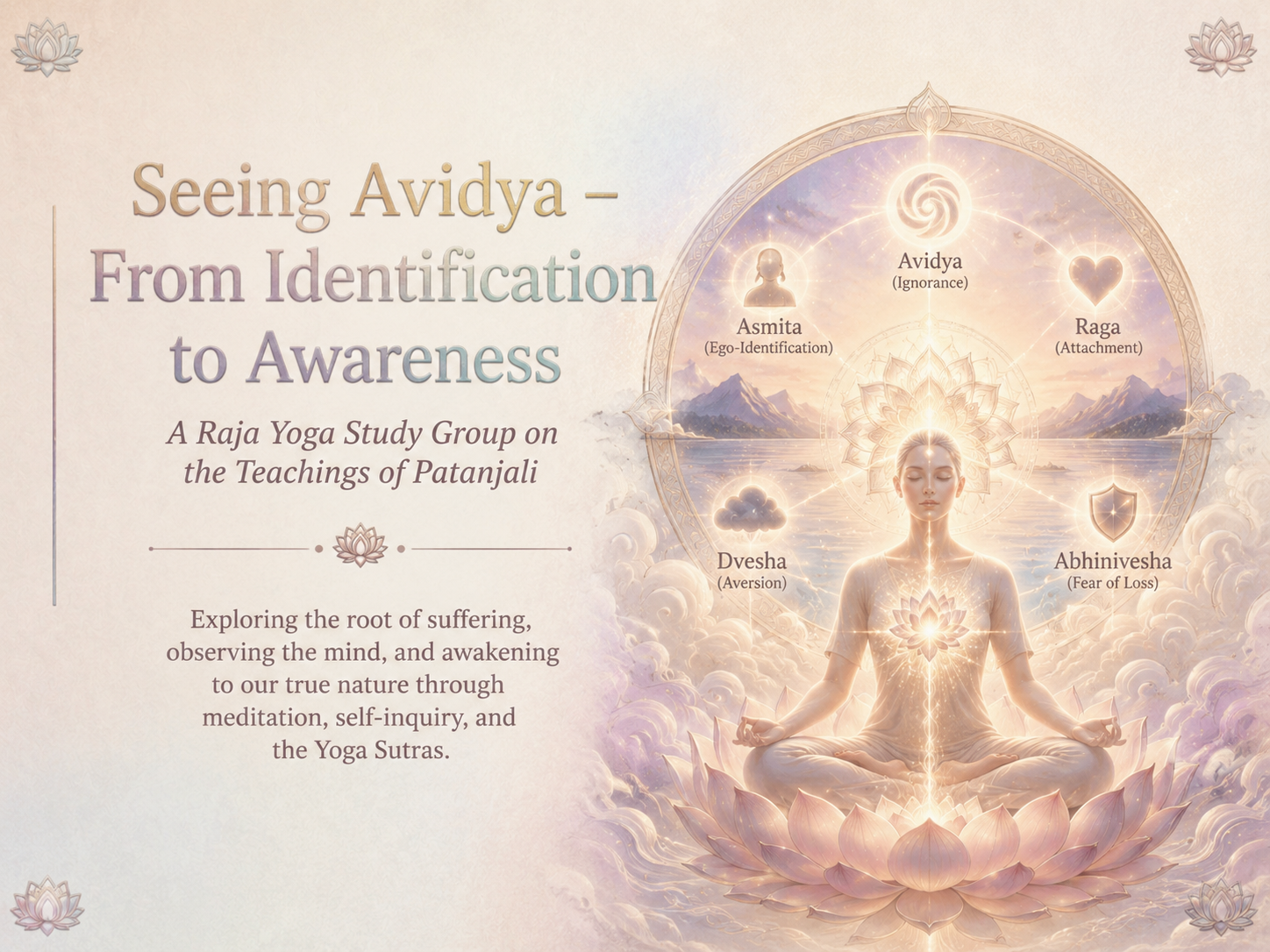
Entering the Heart of Raja Yoga — Self-Inquiry, Avidya & the Yoga Sutras
Preparing the Ground for a Deeper Understanding of the Yoga Sutras
Welcome — Entering the Practice of Self-Observation
This session is an invitation to move beyond intellectual understanding and begin observing directly the movements of the mind.
Together, we will explore the teachings of Patanjali through meditation, self-inquiry, reflection, and discussion.
Rather than simply studying Avidya conceptually, we will begin to recognize how identification forms within our own experience:
- identification with thoughts
- emotions
- roles
- stories
- the body and mind
Through guided awareness practices, journaling, contemplation, and group sharing, we begin the journey from false identification back to awareness itself.
A Guided Self-Inquiry & Awareness Practice
In this guided Raja Yoga practice, we explore the movements of the mind through direct observation, self-inquiry, meditation, and reflection.Together, we begin recognizing Avidya — mistaken identification — and observe how thoughts, emotions, roles, and limiting beliefs shape our perception of ourselves and the world.This practice is an invitation not merely to think about awareness…but to begin experiencing it directly.
Raja Yoga Review & Knowledge Reflection
This interactive Raja Yoga review is designed to help deepen and validate your understanding of the teachings explored so far.
Together, we revisit:
- the foundations of Raja Yoga
- the teachings of Patanjali
- Avidya and false identification
- the existential questions of life
- and the journey from identification toward awareness and Samadhi.
More than a simple quiz, this reflection is an invitation to observe, contemplate, and integrate the teachings into direct experience. 🧘✨
What is a sutra ?
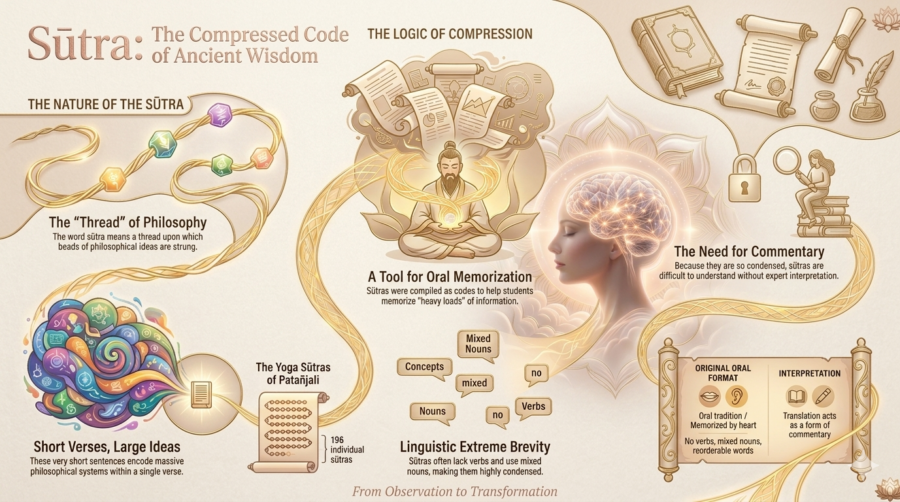
The word sūtra means “thread.”
A sūtra is a very short verse that contains deep philosophical and spiritual teachings.
In ancient times, teachings were passed orally and memorized by students. To make these vast teachings easier to remember, the sages condensed them into short verses, like spiritual codes.
Because the sūtras are extremely concise, they are difficult to understand without commentary. Even translation itself becomes a form of interpretation.
In the Yoga Sutras of Patanjali, there are 196 sūtras containing the essence of the yogic path.
The Four Pādas of the Yoga Sūtras
The Yoga Sutras of Patanjali are divided into four chapters called Pādas, meaning “paths” or “steps.”
Together, these four Pādas guide the seeker from a disturbed and conditioned mind toward clarity, inner stillness, Samādhi, and ultimately liberation.
Each Pāda reveals a different stage of the yogic journey:
from understanding the nature of the mind,
to spiritual practice,
to higher realization,
and finally to complete freedom.
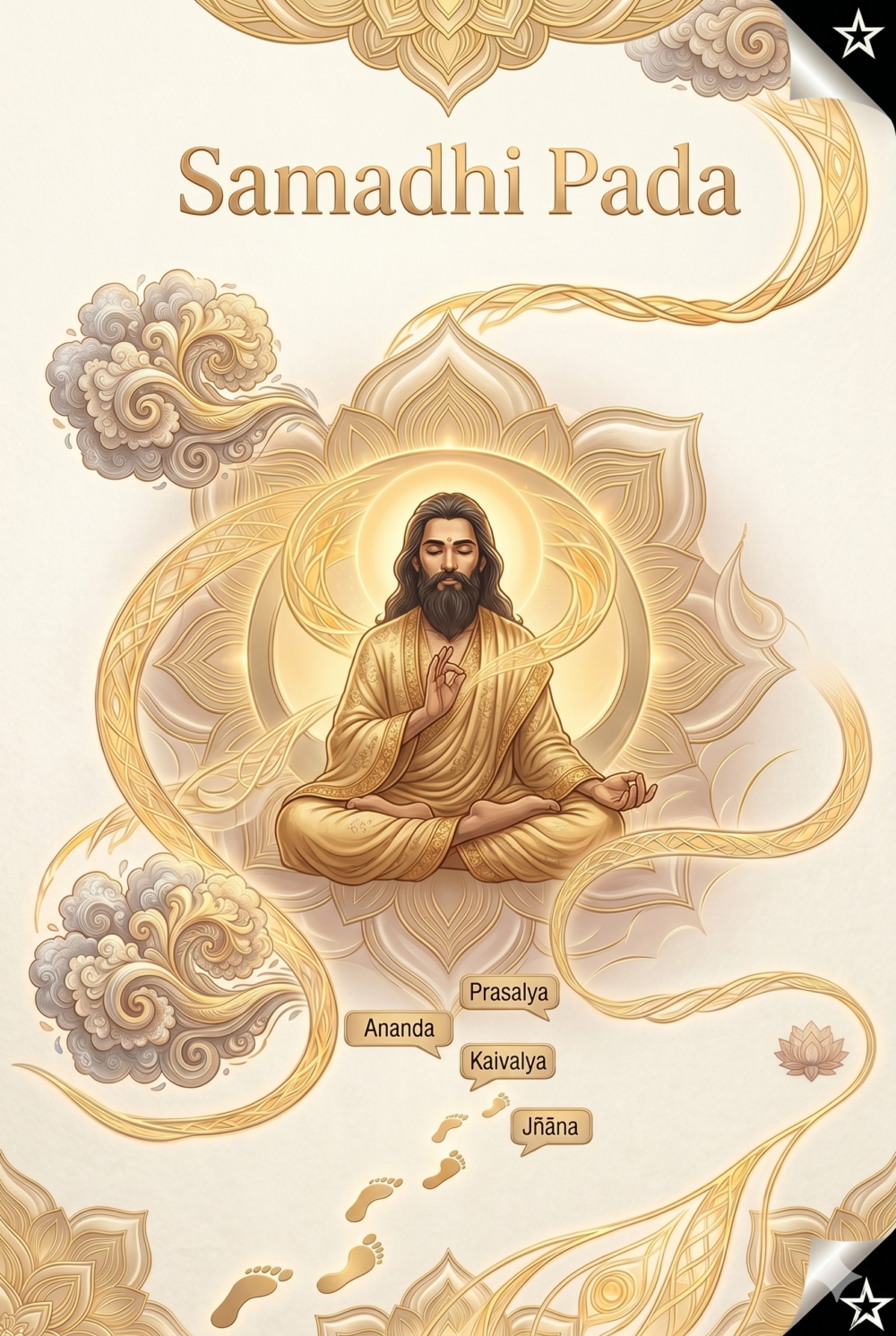
Teaching of Swamiji
Explanation
The Samādhi Pāda introduces the essence and goal of yoga. It explains the nature of the mind, its fluctuations, and the possibility of reaching a state of profound inner stillness called Samādhi.
Swamiji explains that the mind, in its ordinary condition, is constantly disturbed by thoughts, reactions, memories, desires, fears, and identifications. Because of these disturbances, reality is not perceived clearly.
This chapter presents yoga as a process of mental healing and purification. Through concentration, meditation, devotion, dispassion, and sustained practice, the mind gradually becomes calm, focused, and transparent.
Patañjali also describes different levels of Samādhi and explains the obstacles that prevent the seeker from reaching deeper states of awareness.
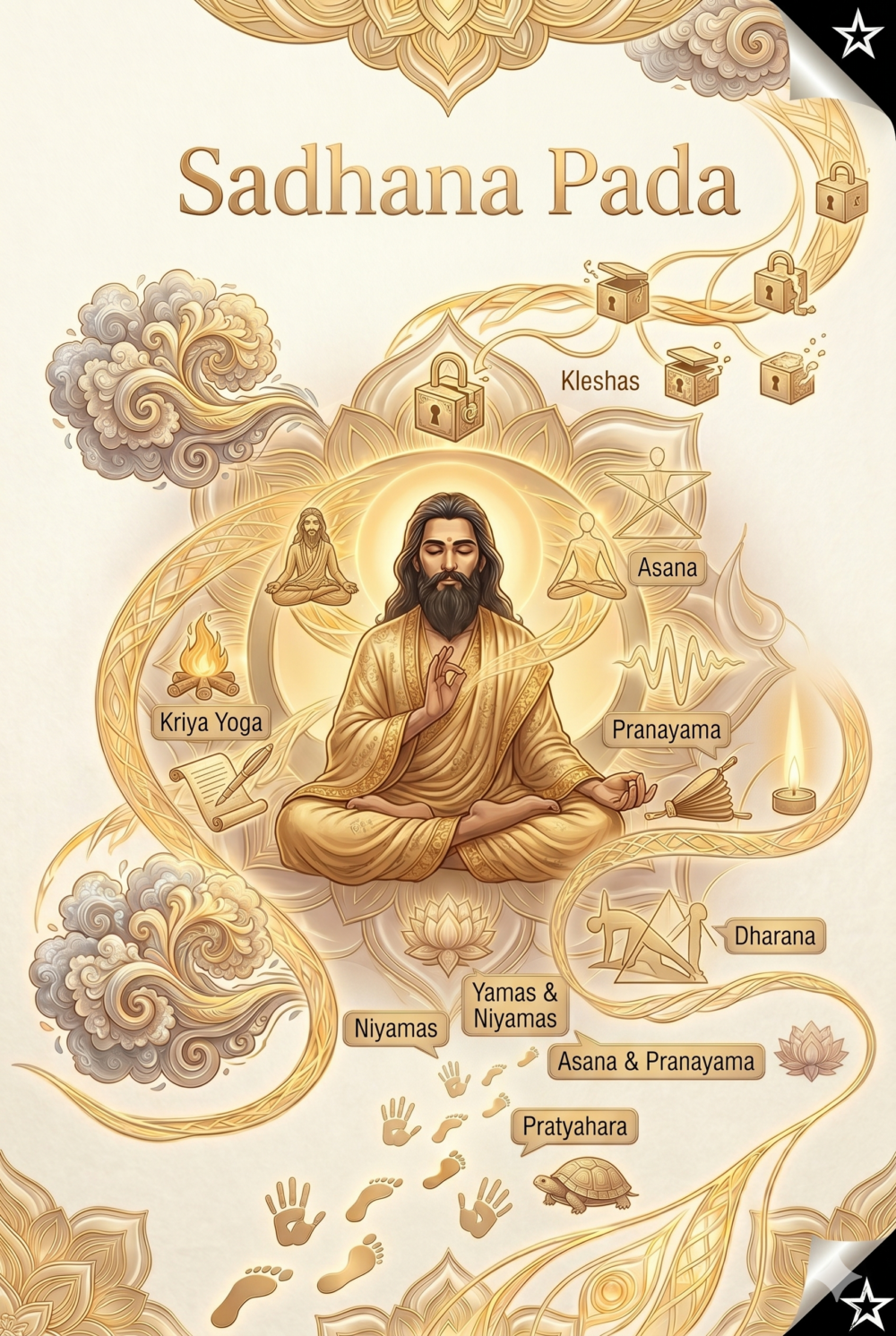
Teaching of Swamiji
Explanation
The Sādhana Pāda focuses on practice and spiritual discipline.
Swamiji explains that most seekers are not yet ready for the highest states of meditation because the mind is burdened by conditioning, attachments, emotional disturbances, and spiritual ignorance. This chapter therefore provides practical methods to purify and prepare the mind.
Patañjali introduces Kriyā Yoga — discipline, self-study, and surrender to the Divine — as a foundation for transformation. He also explains the Kleśas, the root causes of suffering, including ignorance, egoism, attachment, aversion, and fear.
The second half of this chapter presents the famous Aṣṭāṅga Yoga, the eight limbs of yoga:
Yama, Niyama, Āsana, Prāṇāyāma, Pratyāhāra, Dhāraṇā, Dhyāna, and Samādhi.
Swamiji explains that these practices gradually purify the body, senses, emotions, and mind, preparing the seeker for higher realization.
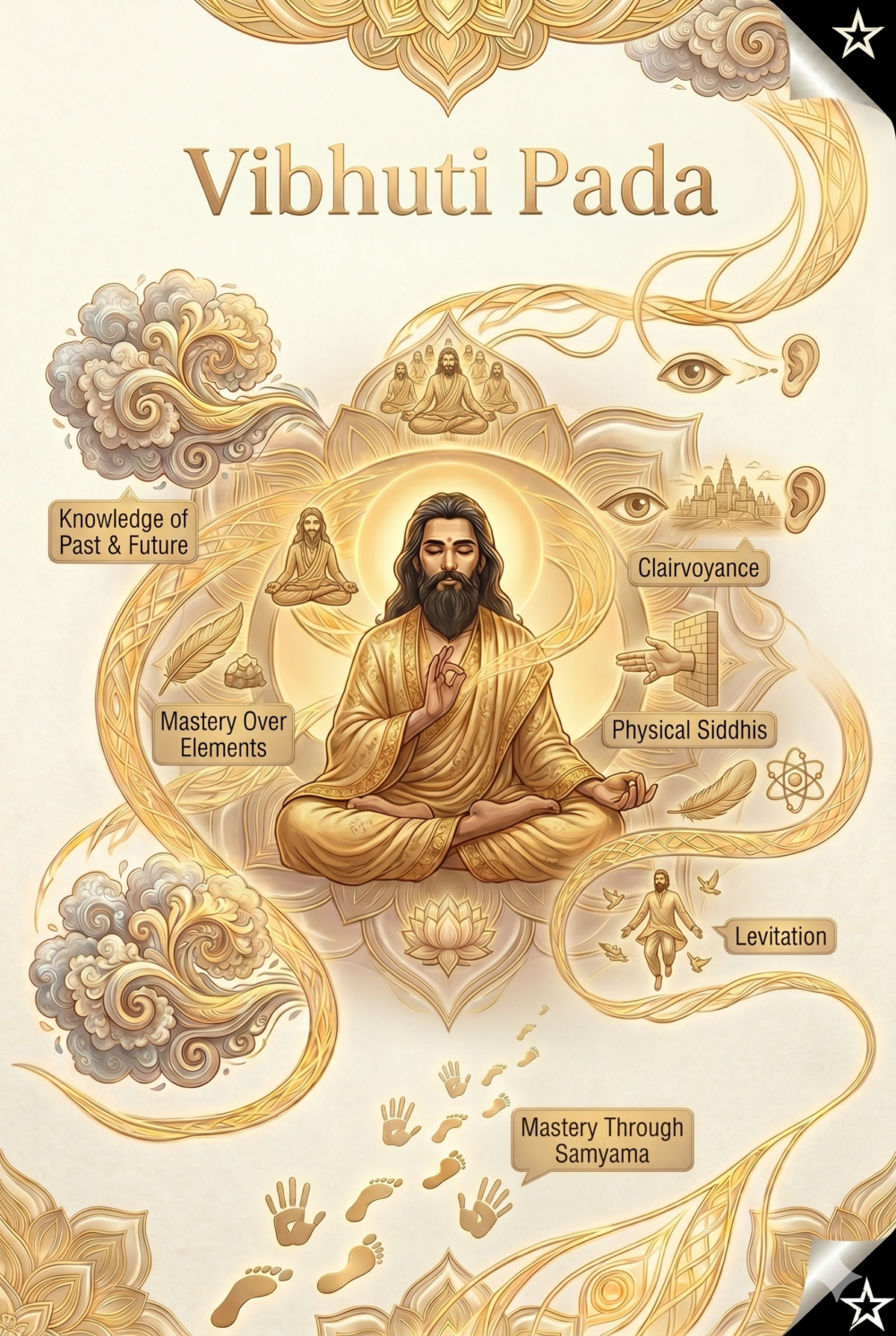
Teaching of Swamiji
Explanation
The Vibhūti Pāda explores the deeper stages of concentration, meditation, and Samādhi.
Swamiji explains that when the mind becomes purified and one-pointed, it gains extraordinary power, clarity, and subtle perception. Through the practice of Samyama — the combined practice of concentration, meditation, and absorption — the yogi can penetrate deeply into the nature of reality.
Patañjali describes how advanced concentration can reveal knowledge beyond ordinary perception and awaken higher capacities of the mind. These are called Vibhūtis or siddhis.
However, Swamiji emphasizes that these powers are not the final goal of yoga. They are only by-products of concentration and can become distractions if the seeker becomes attached to them.
The real purpose of this chapter is the refinement of awareness and the expansion of spiritual understanding.
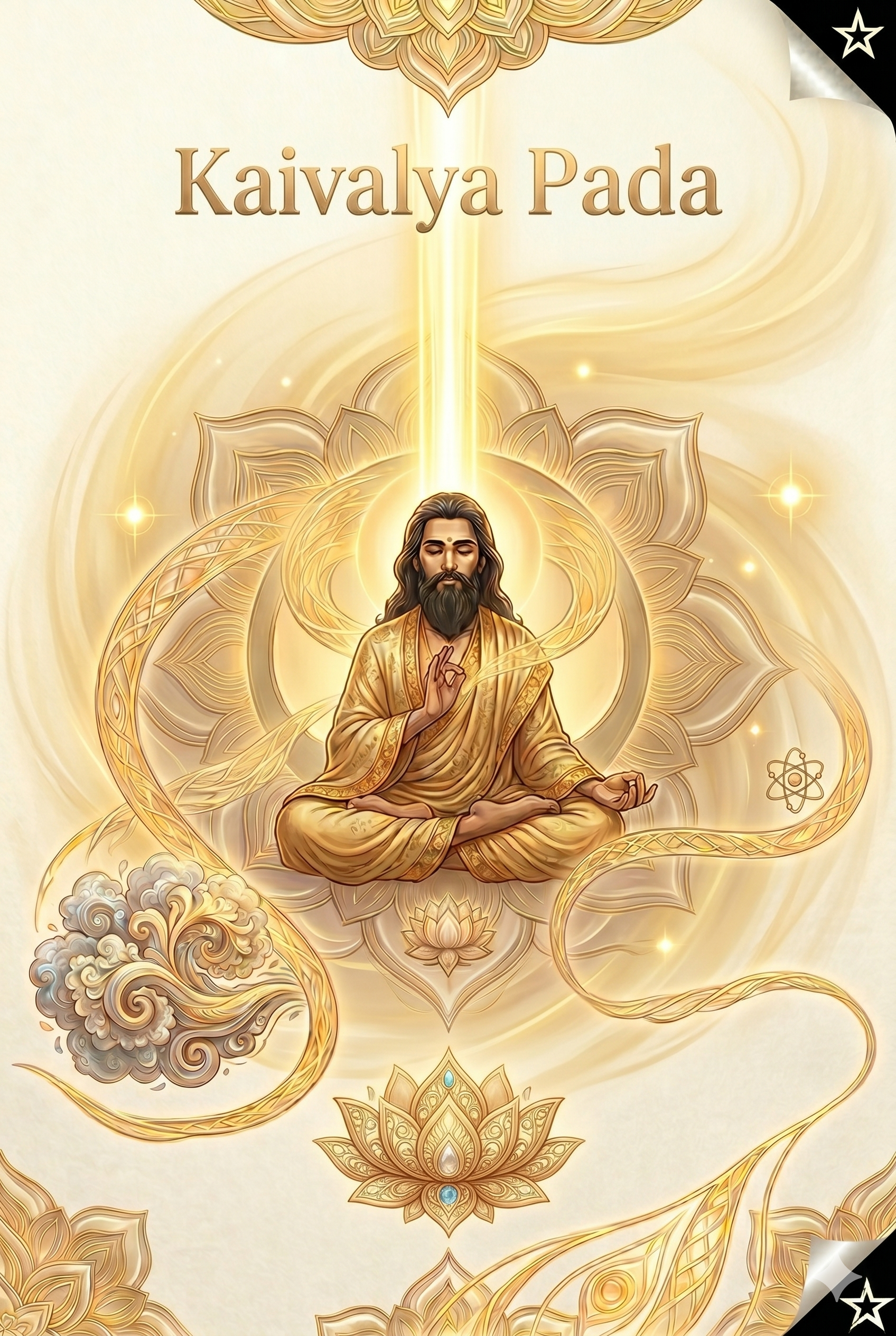
Teaching of Swamiji
Explanation
The Kaivalya Pāda reveals the highest goal of yoga: liberation and absolute freedom.
Swamiji explains that suffering arises because consciousness identifies itself with the mind, the body, emotions, thoughts, and the changing world. Through yoga, this false identification gradually dissolves.
In the highest realization, consciousness stands completely free from the fluctuations of nature and the limitations of the mind. Reality is perceived directly, without distortion or mental projection.
This state is called Kaivalya — absolute freedom, pure awareness, and complete independence from all conditioning.
The journey that began with the purification of the mind ends in transcendence of the mind itself.
Conclusion
Raja Yoga is not merely a philosophy to study, but a path of direct observation and inner transformation.
As we continue this journey together, may these teachings help us become more aware of the movements of the mind, the patterns of identification, and the deeper awareness that remains untouched behind every experience.
Little by little, through observation, reflection, practice, and inquiry, the path of Raja Yoga leads us from confusion toward clarity, from identification toward freedom, and ultimately toward the stillness of Samadhi.
May this study become a living experience within us. 🧘✨
Practice of the Week with Swamiji
Realize Cosmic Intelligence
Sankalpa — The Power of Inner Resolve
A sankalpa is not a wish —
it is a commitment to transformation.
This is my sankalpa
May I develop the awareness to observe the movements of the mind without becoming lost in them.
May I recognize false identification, release limiting beliefs, and remember that thoughts, emotions, and roles are only passing movements within consciousness.
May observation become stronger than conditioning, and may this practice gradually lead me toward greater clarity, peace, and inner freedom. 🧘✨
What is yours?
Raja Yoga Teachings with Swami Shambhudevananda